Beyond taste: the world of texture in wine
Two wines can smell almost the same and feel completely different. One glides through the mouth like silk, the other clings to the gums like strong tea. That difference is texture, and it is the part of tasting that is hardest to put into words. In this guide: where texture comes from, which words describe it, and what we found when we put all 62 of our wines on one map.
Texture is touch, not taste
The tongue recognises five tastes: sweet, sour, bitter, salty and umami. Everything else, what you feel as the wine flows, clings or fades, comes from the same nerves that sense pressure, heat and roughness. That is why it is easy to get confused: “dry” can describe a wine with no sugar, which is taste, or the feeling of the mouth drying after a sip, which is texture.
Tannin is the best example. You can barely taste it. It binds to the proteins in saliva, the saliva loses its slipperiness, and the mouth feels rough and dry. That is why, after a young red, your teeth feel as they do after a cup of black tea that brewed too long.
Six things that build texture
Tannin. It comes from the skins, seeds, stems and wood. The longer the juice stays with the skins, the more of it there is, which is why it is found in red and orange wines and not in ordinary whites. Ripe tannin feels like velvet; green tannin like sandpaper.
Acidity. It makes the mouth water and sharpens the feel of the tannin. It gives a wine tension: an acidic wine feels narrow and tight, a wine with little acidity feels broad and soft.
Alcohol. It gives weight and warmth. In an experiment on three Rieslings, added alcohol increased the sense of body and viscosity in two of them, and increased the heat in all of them.
Sugar. It adds viscosity and roundness. Even a few grams that you cannot taste as sweetness can soften a very acidic wine.
Bubbles. Carbon dioxide is also picked up in the mouth by the sour-taste cells, which is why bubbles feel prickly. A coarse bubble stings; a fine bubble feels almost like cream.
Lees and time. When a wine spends months on its lees, the yeast releases substances from its cell walls that round the wine and give it a creamy texture. The glossary explains the difference between fine lees and full lees. Skipping filtration also keeps some of this texture: why unfiltered wine is cloudy.
The words: a small texture vocabulary
There is no single agreed list, but these are the words tasters use most. In Australia, researchers developed a “mouth-feel wheel” for red wine, with dozens of terms sorted into families. For most tastings, twelve words are enough:
What we found when we put our 62 wines on a map
Every wine on the site has a tasting profile, in which we graded body and grip from 1 to 5: grip meaning how much the wine clings to the gums and cheeks. That sensation is called astringency, and it comes mostly from tannin. We put them all on one map:
Body and grip are two separate things. Our fullest whites, Zillinger’s Hirschenreyn and Marto’s Côte de Flon, score 4 for body and 1 for grip: they fill the mouth without any roughness. Their weight comes from ripeness, alcohol and a long time on the lees, not from tannin.
Grip comes from the skins. Only eight wines reach 3 or more for grip: four deep reds and four orange wines. Sic Semper Tyrannis, an orange wine from Quantum that spent a week on the skins, grips as hard as Comondor, our fullest red. No white that did not ferment on its skins goes above 2.
Most of our wines sit in the middle. 34 of the 62 are at body 2 or 3 and grip 2: neither heavy nor thin, with a gentle touch. That is the style of most of the winemakers we work with. The texture comes from the lees and the skins, not from weight.
The sparkling wines are the lightest. Piri’s three pét-nats score 1 for body and 1 for grip. For them the texture is the bubble itself, and a little yeast left in the bottle.
Myth: legs in the glass
The drops that run down the side of the glass after a swirl are called legs or tears, and many people believe they show quality or body. They do not. They form because alcohol evaporates from the thin film on the glass faster than water, and the change in surface tension pulls the liquid upwards until it falls in drops. More alcohol, more legs. About texture in the mouth they say almost nothing.
Glycerol, often credited with body, also matters less than people think. A dry wine usually has 4 to 10 grams per litre. In an experiment from 1984, tasters did not find the wine any thicker until the glycerol reached about 26 grams per litre.
How to practise: three sips
The best way to learn texture is to compare. Open three different wines, take a sip of each and hold it in your mouth for a few seconds. Ask: where do I feel it, at the tip of the tongue, in the middle or at the edges? Does it flow or cling? What is left after swallowing?
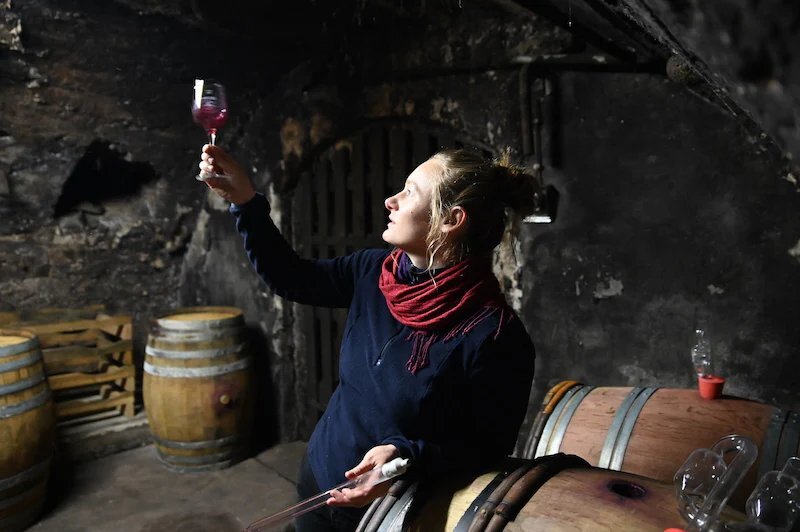
A good trio to start with: Piri’s Pét-Nat Weiss, light and prickly; Zillinger’s Hirschenreyn, full and taut with no grip; and Sic Semper Tyrannis, which clings to the gums. Three wines, three completely different answers to the same questions.
Each wine’s tasting profile on the site also has a mouth map: where the acidity sits, what shape it has and how the wine changes from the first sip to after swallowing. It is worth opening next to the glass.
Six wines, six textures
Questions
14.11.2026