Organic, biodynamic, natural: what’s the difference
Next to every estate in our catalogue we name its certification: certified organic, certified biodynamic, biodynamic methods, or certified sustainable. All of these describe what happens in the vineyard. “Natural” describes what happens in the cellar. Here is what stands behind each word.
Certified organic
Farming without synthetic pesticides or chemical fertilisers. The EU sets the rules, and an inspection body checks the vineyard and the cellar every year. The label carries a green leaf made of stars and the inspector’s code: AT-BIO-402 in Austria, DE-ÖKO-022 in Germany.
At Christoph Neumeister’s in Styria, certified organic since 2013, it looks like this: no herbicides, no pesticides, no chemical fertiliser — compost and a diverse cover crop.
The certification covers the cellar too: organic wine allows less sulphur and fewer additives. But commercial yeast, fining and filtration are still allowed.
Certified biodynamic
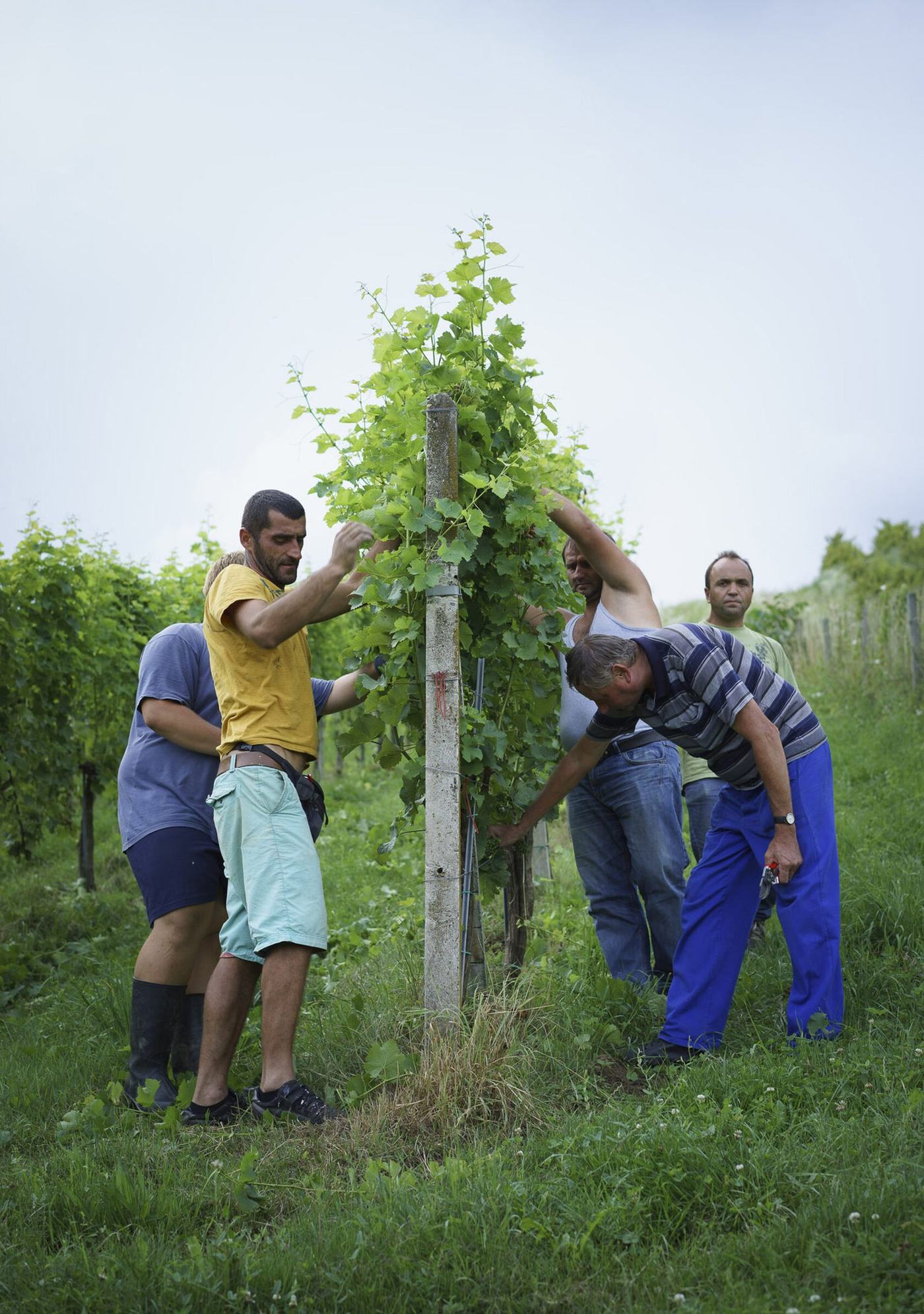
Biodynamics starts from the organic rules and adds to them. The idea comes from a series of lectures Rudolf Steiner gave in 1924: the vineyard is a single organism, in which soil, plants and animals feed one another.
In practice, growers make preparations from compost, medicinal herbs and cow manure buried inside a cow horn over the winter, and spray them in tiny doses on the soil and the vines. The work is timed by a calendar tied to the moon.
Two bodies certify biodynamic estates: Demeter, the oldest in the world, and respekt-BIODYN — an association of biodynamic estates in Austria, Germany, Italy and Hungary, with binding vineyard and cellar rules and a yearly inspection. Gerhard and Brigitte Pittnauer of Gols are among its founders, in 2007.
Biodynamic methods
Some estates farm biodynamically but hold only an organic certification, or no biodynamic one at all. For them we write “biodynamic methods”. Felix & Alex in Gols work this way. When there is no certificate, we say it is the producer’s declaration.
Certified sustainable
A certification that looks at the whole farm: energy, water, soil, workers and biodiversity. It does not ban all chemicals, so it is less strict than organic. The Wohlmuth family in Kitzeck im Sausal, the highest wine village in Austria, is certified Nachhaltig Austria.
And what is natural?
Natural wine starts in an organic or biodynamic vineyard and continues in the cellar: spontaneous fermentation — with the wild yeasts found on the grapes and in the cellar, no commercial yeast added — no fining, no filtration, and no added sulphur or very little of it.
In most countries natural wine has no legal definition, so some associations set their own rules. Autentisté, the natural winemakers’ association of Czechia and Moravia, requires no additives, no filtration, no stabilisation. Martin Vajčner has been a member since 2022.
In short: organic, biodynamic and sustainable are vineyard certifications. Natural is a way of working in the cellar. A wine can be certified organic and not natural, and a good natural wine always starts in a clean vineyard.
Wines by certification
Questions
Want more? Our guide to natural wine · Meet Pittnauer
24.10.2026